
Este artículo también está disponible en Español
STOP CALLING US HEROES
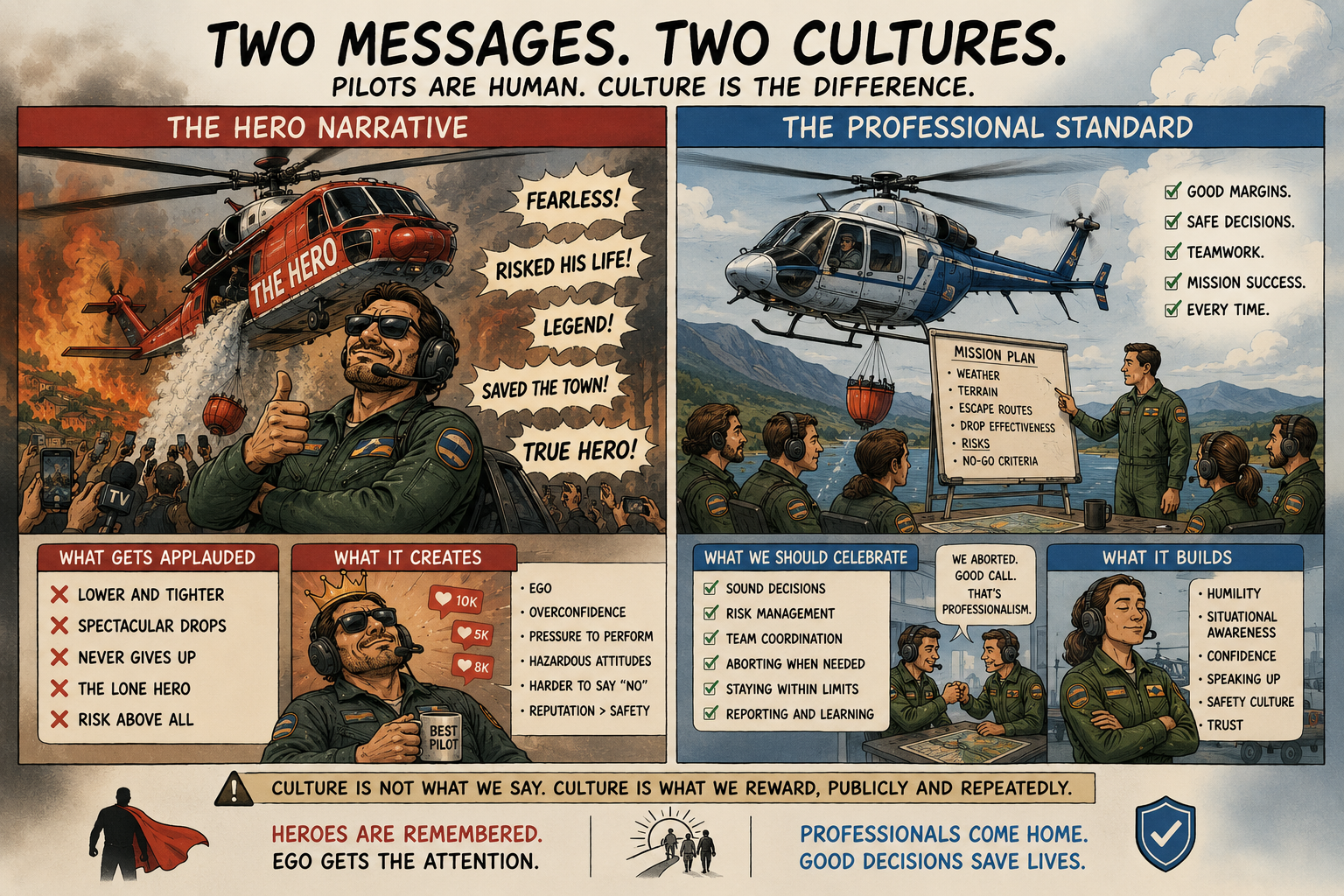
Aerial firefighting pilots are repeatedly portrayed as heroes, warriors and fearless individuals who risk their lives to save communities. This language is usually dismissed as harmless recognition. It is not harmless. Aviation spends enormous resources teaching pilots to manage ego, hazardous attitudes, authority gradients, emotional pressure and overconfidence. At the same time, journalists, the public and even corporate communication departments reward individual courage, visible risk-taking and exceptionalism.
These are two opposing training systems.
This article combines frontline experience with evidence from aviation psychology, organizational behaviour, social learning and safety culture. It proposes that heroic communication can act as behavioural reinforcement: it gives prestige to selected individuals, influences who is treated as a model, strengthens informal authority and makes conservative decisions more socially costly.
I haven’t found—because none exists—a single study proving this thesis. What does exist, however, is a strong convergence of evidence supporting each of the key links in that chain. In a safety-critical organization, that should be enough to stop applauding the wrong things.
If this topic interests you, stay with me for the next ten minutes. I hope we’ll both learn something along the way!
A pattern, not an isolated headline
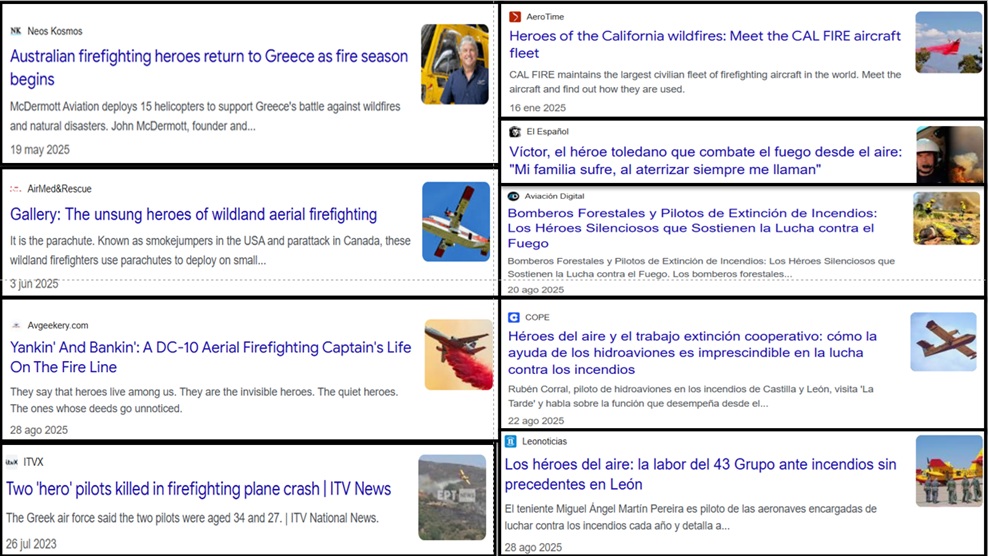
Figure 1. Illustrative sample of recurring hero framing in aerial-firefighting media. Screenshots supplied by the author. The collage demonstrates a narrative pattern; it does not assess the operations or individuals depicted.
I am tired of heroes
“The heroes fighting the flames from the sky.”
“Fearless pilots risk their lives to save the town.”
“The last line of defence against catastrophe.”
“Infinite courage.”
Oh dear…here we go again.
Every wildfire season, the same headlines return.
Enough.
Not sure about you, but I am tired of the hero narrative. Not because I do not respect aerial firefighting pilots. I have spent most of my professional life among them. I know the commitment, preparation and personal sacrifices this career demands.
I also appreciate the work of journalists, photographers and communication professionals. Most of them are trying to do exactly what they should: tell compelling stories, recognize extraordinary people and bring public attention to a profession that often goes unnoticed.
The problem is not their intention, the problem is that aviation is not like most professions.
In high-performance, safety-critical environments, the stories that inspire the public can unintentionally reinforce the very attitudes that pilots spend years learning to control. A headline that celebrates courage, fearlessness and sacrifice may be excellent journalism. It may also be poor human factors.
That is the paradox.
In aviation we try to remove from the cockpit:
- Ego
- Impulsivity
- The need to impress.
- The inability to say no.
- The belief that completing the mission proves personal worth.
- The fear of disappointing people on the ground.
- The pressure to defend a reputation.
We spend hours in CRM classrooms discussing these threats. Then somebody publishes a photograph of a pilot standing on an aircraft, fists raised, and calls him a fearless hero.
Ouch!
All the work performed from Safety and CRM wasted.
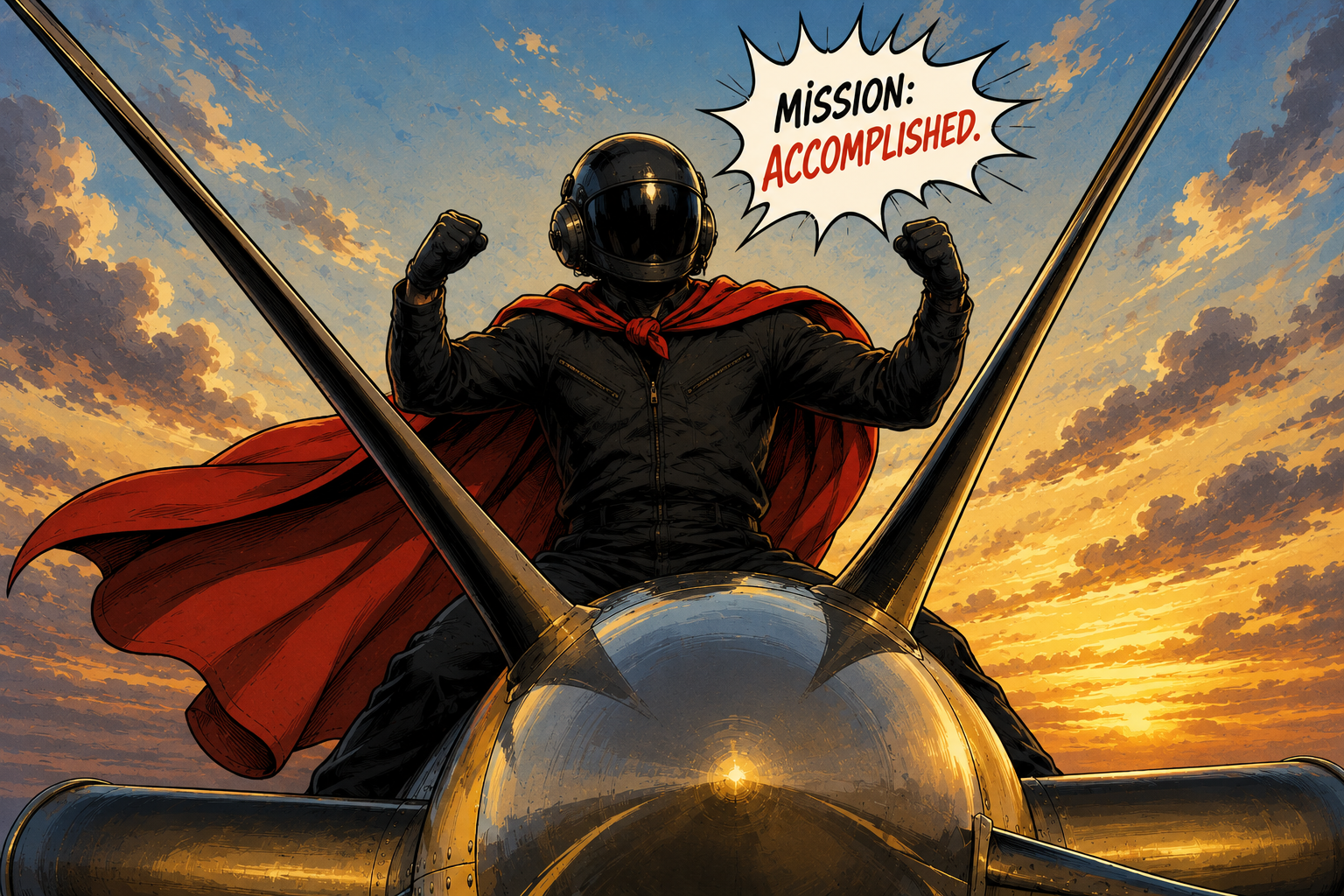
That is not merely inconsistent. It is organizational self-sabotage.
CRM tries to build disciplined professionals.
Heroic storytelling tries to build exceptional individuals. Those identities compete.
We are not heroes
Four years ago, I wrote a much shorter article about this subject. My argument was simple: commitment, professionalism and purpose in a demanding environment—yes. Heroism and deliberately risking our lives—no.
I still believe that.
If you are in a rush, scroll down and continue with the article. If you finish it and want more, come back here for the old article and the video associated to it.
I had a lot of fun putting this video together., and that is part of the problem. For experienced aerial firefighters, this kind of imagery is frustrating—but also strangely funny. We see new operators and pilots walking toward an aircraft as if they were Bruce Willis or Ben Affleck boarding a spacecraft, and it feels completely disconnected from how professionals actually understand this job.
Aerial firefighting should not be an extraordinary emotional event for the people performing it, it should be a repeatable professional activity conducted within defined margins.
The public sees fire, smoke, threatened homes and people running.
We should see wind, terrain, wires, visibility, escape routes, aircraft performance, traffic, load behaviour, system status, tactical effectiveness and abort criteria.
The moment I start seeing myself as the person standing between a town and destruction, I stop evaluating a task.
I start defending an identity.
And that is dangerous.
Heroes have identities to defend.
Professionals have standards to defend.
If a pilot genuinely feels that he or she is risking their life, the correct response is not applause. The correct response is: stop, reassess and restore the margin. If normal operations require heroism, the system has already failed.
The pilot is being trained by two organizations at once
The video shown above was inspired by a specific colleague, but in almost every aerial-firefighting company I have worked for, I have encountered the same profile and organizational contradiction.
The people closest to flight operations—experienced pilots, instructors, safety managers and competent operational supervisors—work to control ego and normalize conservative decisions.
- Threat and Error Management.
- Crew Resource Management.
- Standard operating procedures.
- Self-awareness and emotional regulation.
- Assertiveness and speaking up.
- Go-arounds and abort criteria.
- Mission refusal.
- Humility
- Decision-making based on margins rather than reputation.
At the same time, another group of people is creating the opposite pressure.
The public wants courage.
Sensationalist journalists want a lone protagonist.
Social media wants spectacle.
Non-specialist communication teams want faces, emotion and engagement.
Some managers want a success story.
“Pilot follows SOP, maintains a safe escape path and rejects an ineffective drop” is not considered an exciting headline.
“Hero risks everything to save village” is.
And so one part of the organization teaches the pilot:
You have nothing to prove. You have demonstrated your competence during traning and OPC´s
While another part tells him:
You are extraordinary. People depend on you. Show us what you can do.
CRM pushes in one direction. The hero narrative pulls in the other.
Then, after an accident, everybody asks why the pilot continued.
The fire ground crews already understood this
One of the most intelligent human-factors lessons I have learned in aerial firefighting did not come from a psychologist, a regulator or an academic paper. It came from experienced fire crews—the wildland firefighters and ground supervisors receiving the drops.
In several countries where I have worked, experienced ground personnel were careful about how they praised pilots over the radio after an especially effective drop. Not because they were ungrateful. Not because pilots should never receive recognition. Because they understood that timing matters. Imagine a difficult drop. The aircraft passes over. The line is accurate. The load lands exactly where the ground crew wanted it. Then the radio explodes:
“Awesome drop!”
“Outstanding!”
“That was perfect!”
The pilot feels the reward immediately. Adrenaline is still high. The next circuit has already begun.
What exactly has been reinforced?
Accuracy? Good planning? A stable escape route? Or the fact that the aircraft was lower, tighter or more aggressive than before?
The ground crew cannot necessarily know. Neither can the pilot.
The next drop may become slightly lower. Slightly tighter. Slightly later. Not because the pilot consciously decides to become reckless, but because human behaviour responds to reinforcement.
Experienced organizations therefore often keep operational radio traffic controlled and neutral during the mission. Recognition can come later, in the debriefing, when the manoeuvre can be analysed rather than emotionally reproduced.
That is field wisdom, not a randomized controlled trial. But it raises an obvious question:
If experienced firefighters are careful not to reinforce an aggressive manoeuvre over the radio, why would an organization reinforce it on social media?
A radio compliment may reach one pilot. A corporate post reaches the whole company. It may remain visible for years. It may be seen by young pilots, candidates, clients, managers and members of the public who cannot distinguish technical competence from spectacle.
Every corporate post is an unplanned behavioural training session.
What does the organization admire?
EASA has explicitly highlighted that leaders influence safety culture through their priorities, behaviours, decisions and the way they celebrate success.[1]
That last part matters: how they celebrate success. Culture is not only created through procedures, classrooms and safety bulletins. Culture is created through applause. Every public recognition answers an unspoken question:
What gets admired here?
Is it the pilot who flies closest to the smoke? The pilot whose video looks most spectacular? The person prepared to “do whatever it takes”? The recognizable face who tells the best stories? As Chuck Yeager stated once, “lots of pilots talk a good game, and sometimes their stories get better with each telling.”
Or is it the pilot who identifies an inadequate escape route and refuses the drop that way?
The pilot who returns to base if conditions went out of safe limits?
The pilot who changes the scooping area because boat traffic has reduced the margin or has identified too many shallow areas around?
The instructor who reports their own error?
The pilot who looks completely ordinary because the operation remained completely controlled?
Organizations are always teaching. The only question is whether they realize what lesson they are delivering.
Culture is not only what appears in the Operations Manual. Culture is what gets applauded.
Aviation already has a name for this problem
The FAA does not use the word ego as its principal technical term. It uses something better: hazardous attitudes.
-
Anti-authority.
-
Impulsivity
-
Invulneravility
-
Macho
-
Resignation
The macho attitude is not about masculinity and the moder toxic blame. It comes from the early 90´s.
It is the urge to prove oneself through action and unnecessary risk.
Invulnerability is the belief that adverse outcomes happen to other people.
These attitudes are treated as threats to sound aeronautical decision-making, not as colourful personality traits.[2]
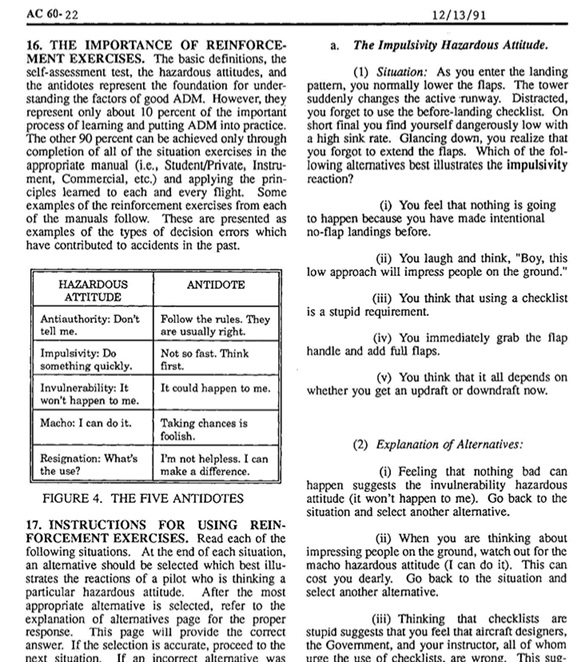
Subsequent research has developed and tested scales intended to measure hazardous attitudes among pilots. They are not merely catchy phrases invented for a PowerPoint presentation; they reflect measurable differences relevant to judgment and risk perception.[3]
Now look again at the language used in heroic communication:
- Fearless.
- Warrior.
- Risked his life.
- Did what others would not.
- Saved the town.
- Never gives up.
- Infinite courage.
That language does not openly instruct a pilot to ignore SOP. It does something more subtle. It gives social value to the psychological territory CRM is trying to control.
A company cannot credibly teach pilots to recognize the need to impress as a hazardous attitude on Monday, and celebrate an image built around courage, dominance and exceptionalism on Friday.
Well, it can. But it should not be surprised by the result.
The following video is a perfect example of this contradiction.
It opens with dramatic music and cinematic storytelling. For a moment, you don’t know whether you’re about to watch a wildfire documentary or the trailer for the next Terminator movie. The language is familiar: Top Gun, wildfire warriors, and at 3:48 comes the classic reaction after a particularly demanding drop: “Impressive!” (Impresionante – in Spanish)
Ironically, the drop shown is uphill, with a limited escape path—exactly the kind of manoeuvre that could become critical if the fire gate failed to release properly.
And yet, the documentary also delivers a very different message.
It highlights teamwork rather than individual glory. It showcases simulator training, recurrent practice, and the constant effort invested in preventing accidents. Those are exactly the behaviours we should be celebrating.
That is the contradiction. One part of the story glorifies the hero. The other explains how professional systems—not heroes—keep people alive.
I genuinely respect the second message.
The first one is exactly what CRM has been trying to undo for the last forty years.
Risk-taking earns status
One of the strongest pieces of evidence comes from a 2021 paper published in the Journal of Applied Psychology.[4]
Across four studies using different samples, methods and operationalizations, van Kleef and colleagues examined how risk-taking affects perceptions of dominance, prestige and leadership. People associated risk-taking more strongly with leader roles than follower roles. Risk-takers were judged as more dominant in three out of three tests and more prestigious in two out of three. In competitive intergroup settings, risk-takers also attracted greater leadership support.
Read that again.
Risk-taking can produce social-hierarchical benefits.
This is not an aviation study, and it does not prove that an aggressive drop produces a safer or more respected pilot. It demonstrates something more fundamental: people can interpret risk-taking as a signal of leadership, competence, prestige or dominance.
Now add the language routinely used in wildfire communication. We describe the fire as an enemy, the campaign as a battle, the pilots as warriors, and the objective as saving the population. Then we place one individual at the centre and praise the visible risk.
Call the fire an enemy, call the pilot a warrior, reward the most dramatic image—and then act surprised when risk becomes prestigious.
Prestige does not remain with the individual
The next link is social learning. Research on prestige-biased learning indicates that people preferentially attend to and copy prestigious individuals, particularly when competence is difficult to evaluate directly. Prestige becomes a shortcut: rather than independently determining who is competent, observers use the attention, respect and deference granted by others as evidence.[5]
That mechanism is highly relevant to aerial firefighting.
Most members of the public cannot evaluate whether the exit path was adequate, whether the load was released within an appropriate envelope, whether a go-around remained available, whether the aircraft crossed an unacceptable obstacle environment, whether the tactical effect justified the exposure, or whether a safer alternative existed.
Many managers and communication specialists cannot evaluate those things either.
They see an impressive manoeuvre, a successful outcome and an experienced pilot. Then the organization adds its logo and its approval.
The individual acquires additional prestige. Other people infer:
“This is what excellence looks like.”
“This is who the company trusts.”
“This is how a good firefighting pilot behaves.”
That can influence young pilots directly. It can also create informal authority among peers.
A publicly celebrated pilot becomes more difficult to question. A criticism of the manoeuvre may be interpreted as jealousy. A safety report may be perceived as an attack on a respected colleague. An instructor challenging the behaviour may appear to be challenging the company itself.
The publication therefore does not only affect the featured pilot’s ego. It changes the social environment around that pilot.
It affects who speaks. Who remains silent. Whose interpretation receives the benefit of the doubt. And who becomes the model.
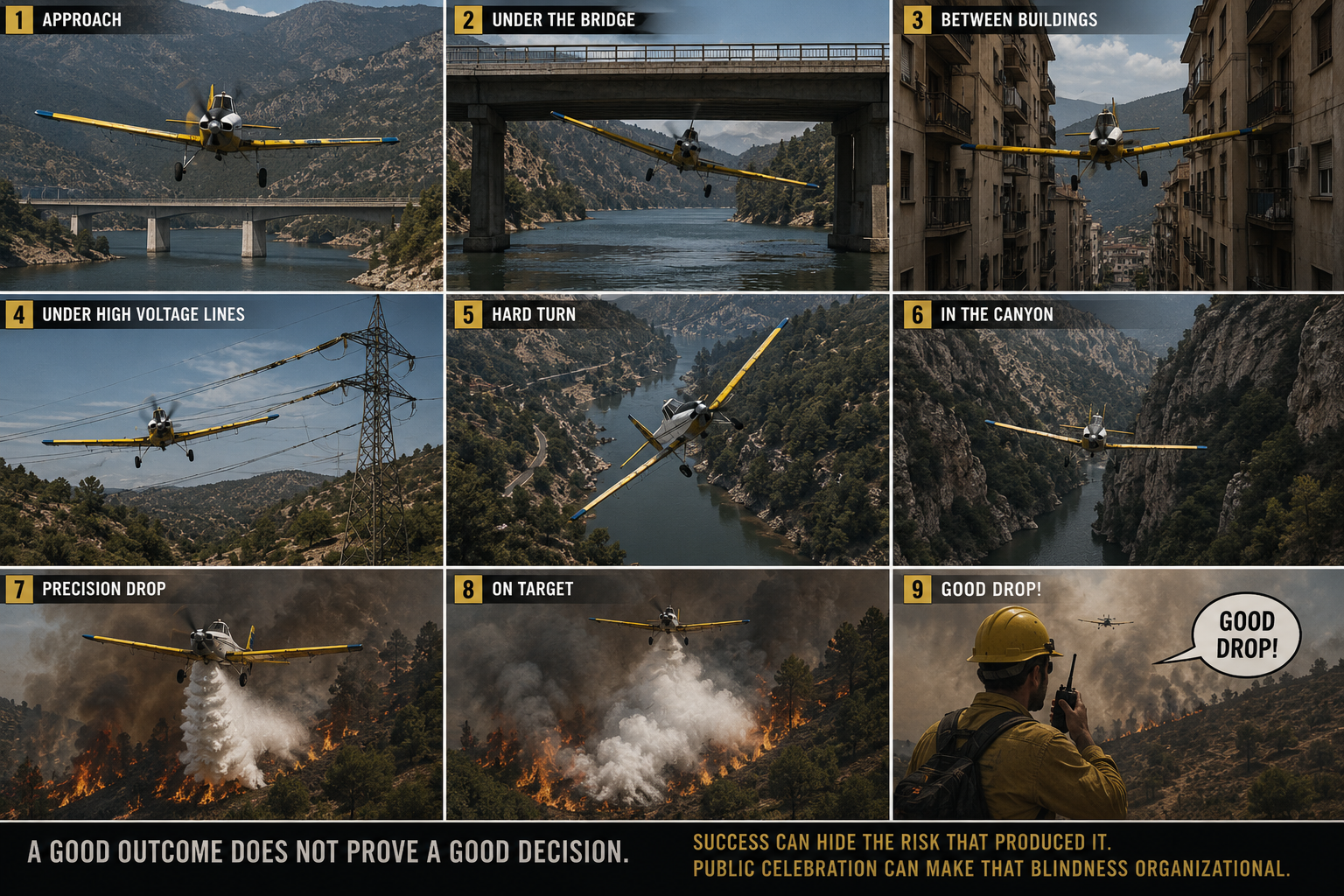
A good outcome does not prove a good decision
Aviation is particularly vulnerable to a simple cognitive trap: nothing bad happened, therefore the decision was good.
That is outcome bias.
A 2023 study asked 60 pilots to evaluate weather-related decisions made under instrument flight rules. The decisions were identical, but their outcomes differed. Pilots judged the same decisions as better and less risky—and reported a greater likelihood of making them themselves—when the scenario ended positively.[6]
This matters enormously in aerial firefighting.
A drop can look effective. The water can hit the target. The aircraft can fly away. The video can become impressive content. None of that proves that the decision preserved an adequate safety margin.
But success is persuasive. The pilot succeeded. The audience applauds. The company publishes. The reputation grows. The next manoeuvre is judged through the halo of previous outcomes.
Success can hide the risk that produced it. Public celebration can make that blindness organizational.
The absence of an accident is not evidence of adequate safety. Sometimes it is merely evidence that the final barrier was not tested hard enough.
The ego problem is real—but use the word carefully
Pilots often speak informally about controlling the “ego monster.” I have used that expression myself.
The scientific language is more precise: overconfidence, self-enhancement, narcissistic traits, poor calibration, status motivation and hazardous attitudes.
A three-study investigation published in the Journal of Behavioral Decision Making found that narcissistic traits predicted greater confidence without greater accuracy. In a betting task, more narcissistic participants lost significantly more points, explained by greater overconfidence and willingness to bet. The authors were careful about generalizing to naturalistic risk-taking, but the decision-calibration finding is relevant.[7]
The point is not that firefighting pilots are narcissists. Nor should safety departments attempt to diagnose personality disorders from photographs or stories.
The point is that inflated self-assessment can degrade decision quality.
CRM therefore tries to build calibration:
- What do I know?
- What do I not know?
- What margin remains?
- What is influencing me?
- Am I continuing because the task is safe and useful, or because stopping would damage my self-image?
- Am I defending the plan—or defending myself?
Hero narratives work against calibration because they turn performance into identity.
Once I am the hero, a routine abort becomes psychologically expensive. Once I am fearless, admitting concern becomes inconsistent with the public image. Once I am the person who saves towns, returning without dropping can feel like failure.
The most dangerous sentence in the cockpit may not be “I am afraid.” It may be: “I have a reputation to maintain.”
Mission pressure is not theoretical
In 2026, the Australian Transport Safety Bureau published an analysis based on interviews with representatives of 11 firefighting agencies and nine aerial-firefighting operators.[8]
All 20 interviewees described some form of pressure for pilots to fly. Nine of 11 agency representatives and four of nine operators described public or political pressure to place aircraft over fires. Eight of nine operators reported pressure from agency personnel. Interviewees also described pressure linked to threatened lives and homes, financial incentives, repeated requests and the visibility of aircraft as evidence that authorities were acting.
The report also questioned whether simply reminding pilots that they can refuse a task is sufficient mitigation.
It is not difficult to see why.
A pilot does not make decisions in a psychological vacuum. Below the aircraft may be houses, firefighters, cameras, politicians, a client, a local community, another pilot who already accepted the mission, a contract measured partly through activity, and a corporate story waiting to be published.
Now add:
“You are our hero.”
“You are the last line of defence.”
“People depend on you.”
Telling that pilot, “You can always say no,” is not a complete safety strategy. The organization has already made no emotionally and socially expensive.
You cannot manufacture mission pressure through communication and then outsource its management to the pilot in command.
Where is the causal proof?
At this point, somebody will ask the predictable question:
Can you prove that calling pilots heroes causes unsafe flying?
There is no study in which one group of aerial-firefighting pilots was exposed to heroic corporate posts and another to neutral communication, followed by measurement of their next-drop height.
That experiment does not exist. It may never exist.
But safety is not a criminal court. We do not need proof beyond reasonable doubt before removing a foreseeable cultural hazard.
The argument rests on converging evidence:
- Aviation formally recognizes attitudes related to proving oneself, invulnerability and impulsivity as hazards to decision-making.
- Risk-taking can increase perceived prestige, dominance and leadership status.
- People preferentially attend to and learn from prestigious models.
- Pilots evaluate identical decisions more favourably when the outcome is positive.
- Overconfidence and inflated self-assessment can produce poorer decisions.
- Aerial-firefighting pilots already operate under documented public, political, financial and situational pressure.
- Organizational leaders influence safety culture through what they recognize and celebrate.
No single study proves the whole chain. Together, they describe a credible mechanism:
Heroic framing → social prestige → increased model influence and informal authority → stronger identity and reputation pressure → reduced calibration or speaking-up → greater difficulty making conservative decisions.
That is not certainty. It is a plausible, preventable risk supported by several independent fields of evidence.
Safety professionals act on less every day.
Waiting for an accident to confirm the model would not be scientific caution. It would be negligence disguised as scepticism.
Corporate communication is part of the SMS—whether it likes it or not
Communication departments sometimes believe operational safety belongs to Operations and Safety.
That is wrong.
The moment a company publishes an aircraft, a manoeuvre, a pilot or a statement about operational standards, it is participating in Safety Promotion.
It is telling employees and the public what good performance looks like, which individuals deserve prestige, which behaviours receive visibility, what the organization considers normal, and what success means.
Communication can manage the message. It cannot independently determine whether a manoeuvre was safe.
A visually successful drop should not become evidence of SOP compliance. A respected pilot’s reputation should not substitute for technical review. A dramatic photograph should not override occupational-safety, PPE or work-at-height principles. And a communications team should never describe a specific operation as compliant with “strict safety protocols” unless someone technically competent has verified that claim.
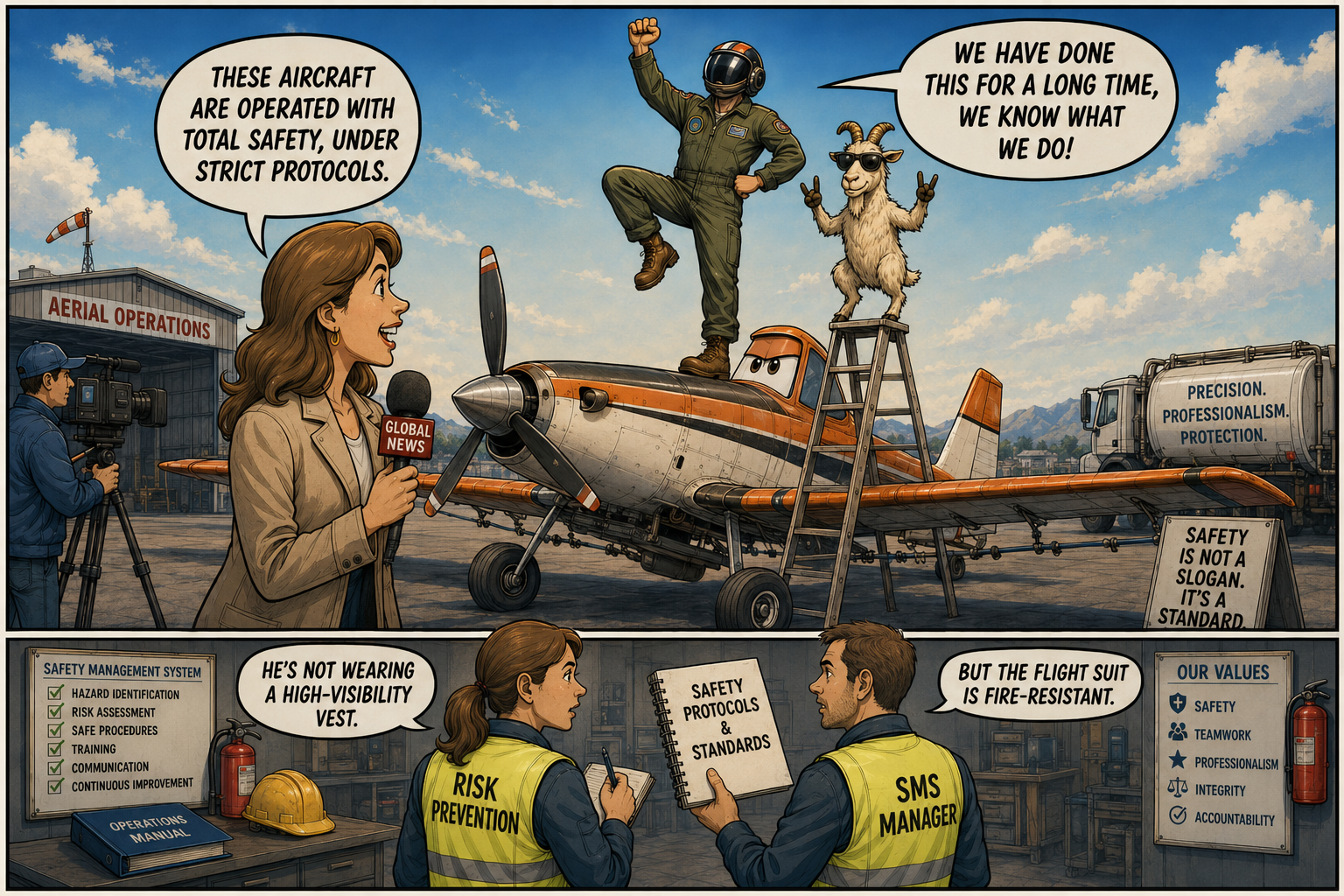
Corporate publications are involuntary audits of organizational culture.
They reveal what the organization notices. What it overlooks. Who approves the content. Whether Operations and Safety are involved. Whether spectacle outranks procedure. Whether the system values a person’s reputation more than objective evidence.
Nobody celebrates the abort
Consider what aviation companies rarely publish.
“Today our pilot rejected a mission because the expected tactical benefit did not justify the exposure.”
“The crew returned with a full load after identifying an unsuitable escape route.”
“Our captain discontinued the approach when the operation ceased to meet stabilized criteria.”
“The pilot changed the scooping site because maritime traffic had reduced the available margin.”
“Our crew reported its own error and enabled us to improve the procedure.”
These may represent the highest forms of professionalism.
But they are visually boring. There is no dramatic photograph. No water exploding across a fire front. No warrior. No saviour. No raised fists.
That is precisely why organizations must make the effort to communicate them.
Otherwise, the only decisions receiving public recognition are successful continuations. The organization unintentionally teaches: flying is visible, dropping is success, aborting is absence, and saying no is not a story.
That is the wrong syllabus.
If we only celebrate completed missions, we are not promoting safety. We are promoting completion.
What should we celebrate instead?
Recognition is not the enemy. Uncontrolled recognition is.
Aviation should celebrate professionals, but recognition should attach to observable behaviour rather than global labels.
Do not call someone fearless. Recognize that they identified deteriorating conditions early.
Do not call someone a hero. Recognize effective coordination with the air-attack platform and ground crews.
Do not praise a spectacular drop. Explain that it was stable, tactically effective and supported by an adequate exit path.
Do not say the pilot risked everything. Say the crew maintained defined margins under demanding conditions.
Do not glorify the person who never gives up. Recognize the professional who knows when continuing has stopped making sense.
A sensible communication policy for safety-critical operations would follow five rules:
- Never associate professional merit with fearlessness, sacrifice or unnecessary exposure.
- Recognize observable competencies: planning, coordination, threat management, SOP discipline, communication, reporting and conservative decisions.
- Give no operational manoeuvre corporate validation before technical review by Operations and Safety.
- Show the system: maintainers, dispatchers, ground crews, air attack, loaders, coordinators and decision-makers—not only the pilot and aircraft.
- Make no-go, abort and go-around decisions visible and respectable.
This does not make communication weak. It makes it credible.
The best aviation communication does not need to manufacture heroes. It shows how competent systems work.
The proffesional profile I personally admire
The best aerial-firefighting pilot I know has probably disappointed many people.
He is effective most of the times.
Comitted to the task.
Has the soul in the game as Nassim Taleb would say.
But at some point, he or she has refused a task. Rearranged a drop. Returned because it was too dark or there was too much smoke. Changed the plan. Told a client that the aircraft would not drop in that way. Looked at a fire, understood the pressure below, and still said “No” because continuing could create an accident—and a much bigger problem.
Nobody writes a newspaper article about those decisions. Nobody calls that pilot fearless. Nobody shares a photograph of the water that was not dropped.
Courage has a place in aviation. But courage is not flying lower or operating negligently. That is easy.
Flying lower makes it easier to hit the target. Winning applause and likes from a non-specialised audience is also easy. Sometimes all it takes is walking toward the aircraft in a flight suit and Ray-Bans.
What is hard is not continuing. What is hard is refusing to defend a reputation or impress your peers—the people who understand the technical details of a drop and the architecture of the decision-making process.
Sometimes courage is accepting that the heroic story will belong to somebody else.
Sometimes it is proposing a different type of drop, or dropping somewhere else where we can still be useful.
Sometimes it is looking completely ordinary.
Stop calling us heroes. Start celebrating professionals.
References
Numbered references correspond to the evidence cited in the text. Links are provided for editorial verification and publication preparation.
- European Union Aviation Safety Agency. (2023). Conversation Aviation, Issue 2: Safety Culture. See the section on safety leadership and how organizations celebrate success. Source
- Federal Aviation Administration. Pilot’s Handbook of Aeronautical Knowledge, Chapter 2: Aeronautical Decision-Making. Hazardous attitudes and antidotes. Source
- Hunter, D. R. (2005). Measurement of Hazardous Attitudes Among Pilots. The International Journal of Aviation Psychology, 15(1), 23–43. https://doi.org/10.1207/s15327108ijap1501_2 Source
- van Kleef, G. A., Heerdink, M. W., Cheshin, A., Stamkou, E., Wanders, F., Koning, L. F., Fang, X., & Georgeac, O. A. M. (2021). No Guts, No Glory? How Risk-Taking Shapes Dominance, Prestige, and Leadership Endorsement. Journal of Applied Psychology, 106(11), 1673–1694. https://doi.org/10.1037/apl0000868 Source
- Jiménez, Á. V., & Mesoudi, A. (2019). Prestige-biased social learning: Current evidence and outstanding questions. Palgrave Communications, 5, 20. https://doi.org/10.1057/s41599-019-0228-7 Source
- Martins, A. P. G., Köbrich, M. V., Carstengerdes, N., & Biella, M. (2023). All’s well that ends well? Outcome bias in pilots during instrument flight rules. Applied Cognitive Psychology, 37(2), 433–442. https://doi.org/10.1002/acp.4046 Source
- Campbell, W. K., Goodie, A. S., & Foster, J. D. (2004). Narcissism, Confidence, and Risk Attitude. Journal of Behavioral Decision Making, 17(4), 297–311. https://doi.org/10.1002/bdm.475 Source
- Australian Transport Safety Bureau. (2026). Analysis of Australian aerial firefighting agency and operator interviews regarding aviation safety (AS-2021-015a). Source
- Navacerrada, É. (2022). I need a hero – Aerial firefighting. Doxastic Safety. Source